
10.08.26
How Technology Is Rewriting the War on Counterfeit Money
How AI & Technology Are Fighting Counterfeit Money | 2026
For centuries, counterfeit currency was detected with trained eyes, magnifying glasses, and UV lamps. Today, the fight has shifted toward artificial intelligence (AI), machine learning, blockchain, and advanced data analytics.
As counterfeiting methods become more sophisticated, governments, financial institutions, and businesses are adopting smarter technologies to protect the integrity of modern currencies.
Why Traditional Detection Methods Are No Longer Enough
Traditional security features continue to play an important role in protecting banknotes. These include:
- Watermarks
- Security threads
- Color-shifting ink
- Holograms
- Microprinting
While these features remain effective, modern printers, scanners, and image-editing software have made producing convincing counterfeit notes easier than in the past.
Banks and retailers also process enormous volumes of cash every day, making manual inspection difficult. Automated verification systems provide faster and more consistent authentication.
Artificial Intelligence and Machine Learning
Artificial intelligence is becoming one of the most effective tools for detecting counterfeit currency.
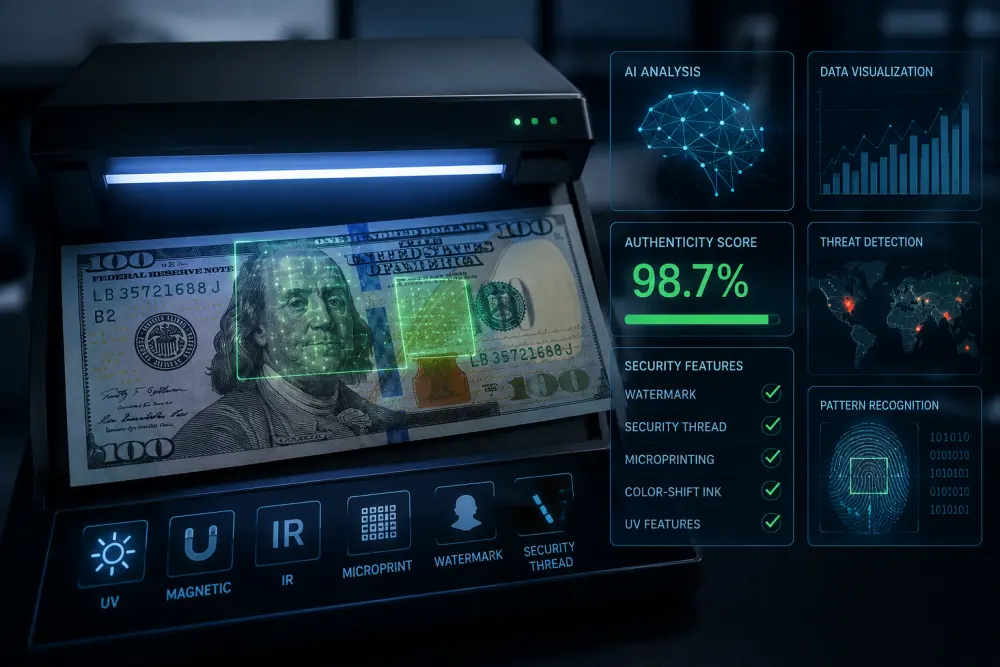
AI-powered systems analyze thousands of microscopic characteristics, including:
- Ink distribution
- Paper texture
- Fiber patterns
- Printing precision
- Security feature placement
Machine learning models improve over time by analyzing genuine and counterfeit banknotes. As they learn from new examples, they become better at identifying evolving counterfeiting techniques.
Many financial institutions now use AI-powered currency sorting machines that combine high-resolution imaging with intelligent software to inspect thousands of notes every hour.
Smartphone Verification Tools
Mobile technology is making banknote verification more accessible.
Some financial institutions have developed smartphone applications that allow users to scan banknotes using a phone camera. These apps help identify visible security features and detect potential irregularities.
Although useful, smartphone verification should be viewed as an additional layer of security rather than a replacement for professional authentication.
Blockchain Beyond Cryptocurrency
Blockchain technology creates secure and tamper-resistant digital records.
Potential uses include:
- Tracking high-value assets
- Improving supply chain transparency
- Recording product authenticity
- Supporting anti-counterfeiting initiatives
Luxury brands, pharmaceutical companies, and electronics manufacturers already use blockchain to help customers verify authentic products throughout the supply chain.
Central Bank Digital Currencies (CBDCs)
Central Bank Digital Currencies represent a different approach to reducing certain forms of fraud.
Instead of relying on physical banknotes, CBDCs exist as secure digital records managed by a central bank.
Potential advantages include:
- Reduced risk of physical note counterfeiting
- Faster digital payments
- Improved transaction tracking
- Greater financial inclusion in some regions
However, CBDCs also introduce new challenges, including cybersecurity, privacy, and system resilience.
The Role of Big Data and Predictive Analytics
Law enforcement agencies increasingly rely on big data to identify suspicious patterns before counterfeit operations grow.
Analysts monitor information such as:
- Geographic clusters of counterfeit reports
- Unusual cash transaction activity
- Distribution trends
- Emerging criminal networks
Predictive analytics allows investigators to detect new threats earlier and respond more quickly.
Challenges of Technology-Driven Solutions
Cost and Accessibility
Advanced AI systems and digital currency infrastructure require substantial investment. Many developing economies may struggle to adopt these technologies.
Criminal Adaptation
Counterfeiters continue to improve their methods. As new security features are introduced, criminal organizations often develop techniques to imitate or bypass them.
Cybersecurity Risks
Digital solutions introduce new risks, including hacking, data breaches, online fraud, and service disruptions.
Public Adoption
Consumers and businesses in cash-dependent economies may be slow to adopt digital verification tools or digital currencies, limiting their effectiveness.
Looking Ahead
The fight against counterfeit money has evolved from physical security features to advanced digital technologies. Artificial intelligence, blockchain, predictive analytics, and digital currencies are reshaping how governments and financial institutions protect modern payment systems.
Technology alone is not enough. Long-term success will also depend on public education, international cooperation, effective regulation, and continued investment in research and innovation.